From an Ash Disposal Site to Slovenia’s Largest Solar Power Plant: How Slovenia Is Transforming Its Coal Regions
What can be done with areas that were part of the coal industry for decades but have since lost their original purpose?
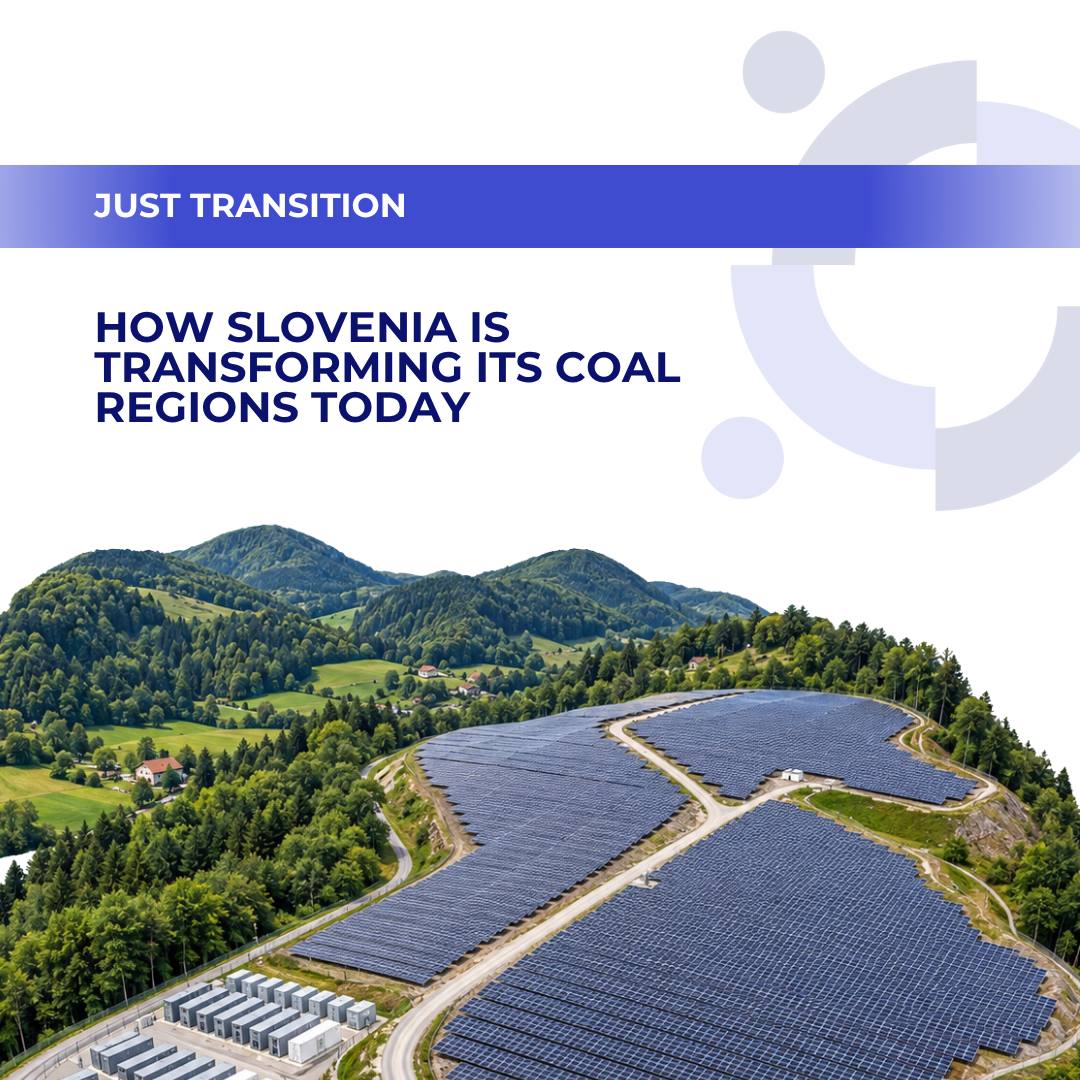
In Slovenia’s Zasavje region, there is already a practical answer to that question. On land that until recently still carried the legacy of coal-based energy, Prapretno now operates as the largest solar power plant in Slovenia.
A site given a new purpose
The first Prapretno solar power plant was commissioned in 2022. It was built on remediated land that had previously been used to store waste from the Trbovlje thermal power plant.
In 2026, the complex was expanded with two additional sections, Prapretno 2 and Prapretno 3, and a battery energy storage system was added. As of September, the facility is operating on a trial basis. Its total installed capacity is 9.8 MW, with more than 17,946 solar modules installed across the site.
The state-owned energy company Holding Slovenske elektrarne (HSE), which is implementing the project, presents Prapretno as one of the examples of the energy transition underway in the Zasavje region. A site that was once part of coal-based energy infrastructure has now been given a new role in renewable energy.
Solar generation combined with energy storage
Importantly, Prapretno is not limited to solar generation alone. A battery energy storage system with a power capacity of 7 MW and a storage capacity of 14 MWh has been installed alongside the solar plant. This makes it possible to better align solar electricity generation with the needs of the power system and the market, while also increasing the flexibility of the entire facility.
According to HSE, once the expansion is fully completed, the complex is expected to generate around 9.8 GWh of electricity per year, comparable to the annual electricity consumption of approximately 2,000 households.
Slovenia’s first energy project supported by the Just Transition Fund
Prapretno is significant not only as a renewable energy facility. It is also the first energy project in Slovenia to receive co-financing from the EU Just Transition Fund.
HSE and the Slovenian government directly link the project to the restructuring of the Zasavje coal region. According to Slovenia’s Ministry of Cohesion and Regional Development, the total value of the Prapretno 2 and 3 project, including the battery storage system, is €13.623 million, of which €4.076 million is provided through the Just Transition Fund.
Importantly, this funding is not only supporting new generation capacity. It is also helping to give a new purpose to a site that was once part of the coal-based energy system.
Why this case matters for coal communities
Prapretno clearly shows that a just transition does not end with the closure of old industrial facilities. The next step is just as important: understanding what new role these sites can play once their previous function has come to an end.
At Prapretno, a former thermal power plant waste disposal site became part of modern energy infrastructure after remediation. A place that was once associated with coal-fired power generation is now serving a very different energy model.
For Ukrainian coal communities, this experience is valuable as an example of how former industrial and degraded land can be reused. This does not mean that every former coal site can or should become a solar power plant. What matters more is the approach itself: finding new functions for these areas that can contribute to the local economy, the energy system and the community’s long-term development.
This case shows what a just transition can look like in practical terms: new uses for land, new infrastructure and the continuation of a region’s energy story on a new technological foundation.