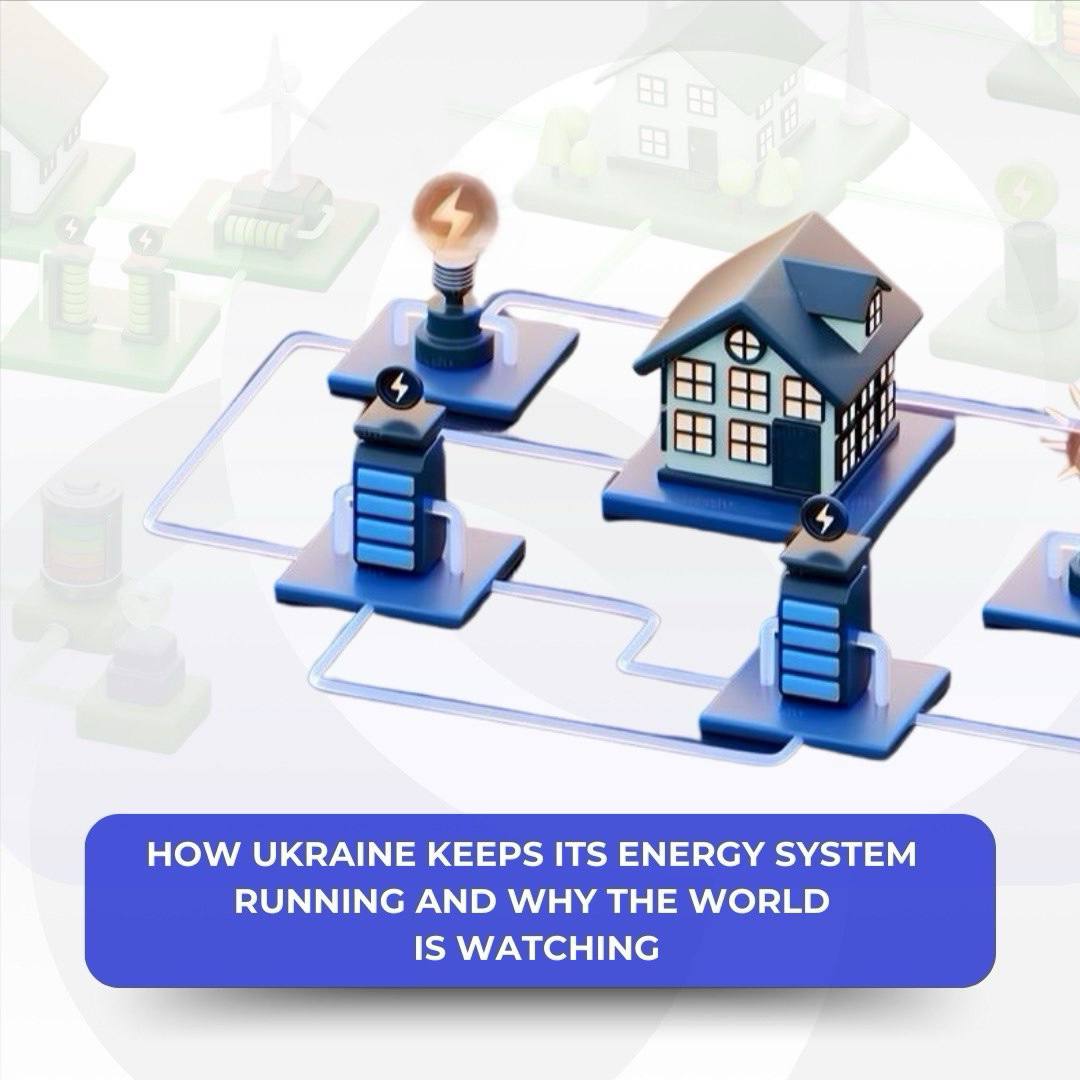
HOW UKRAINE KEEPS ITS ENERGY SYSTEM RUNNING – AND WHY THE WORLD IS WATCHING
Russia’s war against Ukraine has become not only a military, but also an energy challenge of global scale. While missiles and drones relentlessly targeted critical infrastructure, Ukraine’s energy system demonstrated what had once seemed impossible: resilience, adaptability and the ability to respond and recover quickly.
The world has been watching closely. And today, in Brussels, Washington or Tokyo, one hears more and more often: Ukraine’s experience is worth studying and emulating.
In the autumn and winter of 2022–2023, Russia destroyed more than half of Ukraine’s generating capacity and hundreds of substations. It seemed the country would be plunged into darkness for years. But that didn’t happen.
The reasons:
• the coordinated work of Ukrenergo’s dispatchers;
• the rapid mobilization of repair teams;
• decentralization of energy sources;
• the emergency connection of Ukraine to the European ENTSO-E network, which became a true “lifeline”.
Today, European countries are examining this case as an example of rapid response to extreme threats.
Digitalization
Another aspect that drew international attention is digitalization. Automated metering systems, electronic procurement platforms, online tools for demand forecasting — all these became integral parts of Ukraine’s energy sector. Digitalization made it possible to quickly coordinate repair crews, balance the system and make real-time decisions.
Decentralization
Hundreds of communities, businesses, and even households began massively installing solar panels, batteries, generators, and microgrids. These became a buffer that kept hospitals, schools, and critical facilities running.
International institutions such as the IEA (International Energy Agency) and BloombergNEF are actively analyzing this as proof that decentralized energy can ensure resilience even under the worst scenarios.
Demand management and a culture of consumption
Ukrainians demonstrated another unique phenomenon — voluntarily reducing consumption during peak shortages. Public alerts, flexible schedules, and above all, a culture of solidarity helped lower blackout risks.
Today, similar demand-side management models are being discussed in the US, EU and Japan.
Cyber resilience — defense in the shadows
Equally important has been the fight in cyberspace. Ukrainian energy companies have constantly repelled massive cyberattacks — from generation to trading platforms. Ukraine’s experience has already been integrated into NATO reports, and joint drills with CERT-UA and allied government teams have become routine.
Mobile energy as a new paradigm
Another hallmark of Ukraine’s experience is so-called “mobile energy.” Generators, batteries, and transformer modules delivered by volunteers and international partners to communities, hospitals and schools became true lifesavers. This model is now being studied as an element of crisis management in the energy sector.
Why Ukraine’s experience matters to the world
Ukraine’s energy system has become a testing ground for solutions that global players are now studying. It’s not only about crisis management, but also about building a model of future resilience based on:
• flexibility and decentralization;
• digitalization and automation;
• cybersecurity as a core component;
• humanity and a culture of solidarity.
That is why at international energy conferences one hears increasingly often: today, the world is learning from Ukraine how to build the energy of the 21st century — resilient, digital and people-centered.